ARMHS sessions, notes and supervision, from the staff member’s phone
Adult rehabilitative mental health services run on sessions, progress notes and supervision. The ARMHS staff app walks each practitioner through all three, and gives clinical supervisors one queue to review.
Pick a role. One client at Demo Home Care, through every hand it passes. Demo data; nothing is saved.
1Practitioner: start the timed session
2Practitioner: write the progress note
3Client: confirm and rate the session (optional)
4Treatment supervisor: sign off
Session · step 1 of 4
Practitioner: start the timed session
Lee, a mental health practitioner, meets Casey R. (demo client) for basic living and social skills, and taps Start.
✓ Started at now. Location shared at start (Lee said yes).
✓ Ended at 52 minutes later (demo). Location shared at end. 52 minutes.
How this keeps you compliant
Start and end times, with location only when the staff member agrees, show the session happened as billed. ARMHS is a covered Medical Assistance service delivered by qualified staff of a certified provider. Minn. Stat. 256B.0623
Do the step above to continue.
Session · step 2 of 4
Practitioner: write the progress note
Lee writes in their own words. The note coach checks for what every note needs.
Note coach: what this note still needs
Treatment plan goal or objective: missing
What you did and how: missing
The client’s response: missing
Plan for next session: missing
How this keeps you compliant
Every session needs a note with the type, date, start and stop times, location, the treatment plan goal and objective, the intervention, the client’s response, the plan, and the staff signature and credentials (245I.08 subd. 4; Minn. R. 9505.2175). Minn. Stat. 245I.08
Do the step above to continue.
Session · step 3 of 4
Client: confirm and rate the session (optional)
Each agency chooses whether clients confirm sessions. When it’s on, Casey gets an email link, rates the session and signs.
Demo — not a real signature, nothing is saved.
Signed. Here’s what Compliance Pro adds.
1. The Compliance Pro Certified stamp, placed on the document
Compliance ProCertified
Electronically signedDocument ID
2. The Certificate of Completion, added as the last page
Demo Home Care
Compliance Pro · Certificate of Completion
Completed
Document
Envelope ID
Issued
Pages
1
Delivery method
Demo, in your browser
Signers
1.
Role: Demo signer · Signature:
Signer name
Signing reason
I am a party to this document
Signing time
Time zone
Date on form
Audit trail
Document integrity (SHA-256)
Fingerprint of this demo document, worked out in your browser. Change one character and it changes completely. In the app, the certificate is a permanent, tamper-evident record of the signing event.
Demo only: this isn’t a real signature and nothing was sent or saved. Closing the page erases it.
How this keeps you compliant
The client’s own confirmation, certified and time-stamped, backs up the session if it’s ever questioned.
Do the step above to continue.
Session · step 4 of 4
Treatment supervisor: sign off
The note lands in Dr. Patel’s review queue with its due date.
Item
Progress note, Casey R. (demo)
From
Lee, mental health practitioner
Due
Set by your agency’s policy
Status
Waiting for review
✓ Approved at now. Monthly supervision with Lee is logged as due in 30 days.
How this keeps you compliant
Treatment supervisors meet with the staff they supervise at least monthly, and rehabilitation workers are directly observed. One queue keeps notes, supervision and observations from slipping. Minn. Stat. 256B.0623
Do the step above to continue.
Done. How this session flow keeps you compliant
Practitioner: start the timed session. Start and end times, with location only when the staff member agrees, show the session happened as billed. ARMHS is a covered Medical Assistance service delivered by qualified staff of a certified provider. Minn. Stat. 256B.0623
Practitioner: write the progress note. Every session needs a note with the type, date, start and stop times, location, the treatment plan goal and objective, the intervention, the client’s response, the plan, and the staff signature and credentials (245I.08 subd. 4; Minn. R. 9505.2175). Minn. Stat. 245I.08
Client: confirm and rate the session (optional). The client’s own confirmation, certified and time-stamped, backs up the session if it’s ever questioned.
Treatment supervisor: sign off. Treatment supervisors meet with the staff they supervise at least monthly, and rehabilitation workers are directly observed. One queue keeps notes, supervision and observations from slipping. Minn. Stat. 256B.0623
Before ARMHS starts for Casey R. (demo client), the file shows why Casey qualifies.
Diagnostic assessment
Standard DA on file, by a mental health professional
Age
18 or older
Functional domains impaired
3 or more
✓ Eligibility recorded at now. The functional assessment can start.
How this keeps you compliant
ARMHS needs a recent standard diagnostic assessment showing medical necessity, age 18 or older, and impairment in three or more functional domains (256B.0623 subd. 3). The DA is updated when the client’s condition changes markedly. Minn. Stat. 256B.0623
Do the step above to continue.
Assessments and ITP · step 2 of 4
FA due in 7 days: the 10 domains
Casey’s functional assessment was done a year ago. The update is due in 7 days.
How this keeps you compliant
The functional assessment covers these 10 domains, comes after the DA and before the first treatment plan, and is updated on any significant change and at least every 365 days (245I.10 subd. 9). Minn. Stat. 245I.10
Do the step above to continue.
Assessments and ITP · step 3 of 4
LOCUS, with the new FA
Record Casey’s level of care with the updated functional assessment.
How this keeps you compliant
A level of care assessment is part of ARMHS eligibility. DHS asks for a new one when the current DA has none or a new FA is needed, so the LOCUS is kept with the FA date (245I.02 subd. 19; MN DHS ARMHS manual). MN DHS, MHCP Provider Manual: ARMHS
Do the step above to continue.
Assessments and ITP · step 4 of 4
ITP review at 180 days
Casey’s individual treatment plan was signed 176 days ago. The review is due in 4 days.
Demo — not a real signature, nothing is saved.
Signed. Here’s what Compliance Pro adds.
1. The Compliance Pro Certified stamp, placed on the document
Compliance ProCertified
Electronically signedDocument ID
2. The Certificate of Completion, added as the last page
Demo Home Care
Compliance Pro · Certificate of Completion
Completed
Document
Envelope ID
Issued
Pages
1
Delivery method
Demo, in your browser
Signers
1.
Role: Demo signer · Signature:
Signer name
Signing reason
I am a party to this document
Signing time
Time zone
Date on form
Audit trail
Document integrity (SHA-256)
Fingerprint of this demo document, worked out in your browser. Change one character and it changes completely. In the app, the certificate is a permanent, tamper-evident record of the signing event.
Demo only: this isn’t a real signature and nothing was sent or saved. Closing the page erases it.
How this keeps you compliant
The ITP is done within 30 days of the ARMHS start, approved by the client or guardian, who gets a copy, and reviewed every 180 days with a written progress review of the plan before it (245I.10 subd. 8). Minn. Stat. 245I.10
Do the step above to continue.
Done. How this assessments and itp flow keeps you compliant
DA on file, eligibility checked. ARMHS needs a recent standard diagnostic assessment showing medical necessity, age 18 or older, and impairment in three or more functional domains (256B.0623 subd. 3). The DA is updated when the client’s condition changes markedly. Minn. Stat. 256B.0623
FA due in 7 days: the 10 domains. The functional assessment covers these 10 domains, comes after the DA and before the first treatment plan, and is updated on any significant change and at least every 365 days (245I.10 subd. 9). Minn. Stat. 245I.10
LOCUS, with the new FA. A level of care assessment is part of ARMHS eligibility. DHS asks for a new one when the current DA has none or a new FA is needed, so the LOCUS is kept with the FA date (245I.02 subd. 19; MN DHS ARMHS manual). MN DHS, MHCP Provider Manual: ARMHS
ITP review at 180 days. The ITP is done within 30 days of the ARMHS start, approved by the client or guardian, who gets a copy, and reviewed every 180 days with a written progress review of the plan before it (245I.10 subd. 8). Minn. Stat. 245I.10
Lee finished Casey’s functional assessment. Dr. Patel, the treatment supervisor, approves it.
Item
Functional assessment, Casey R. (demo)
From
Lee, mental health practitioner
Approve by
in 14 days (10 business days)
✓ Approved at now. The FA is complete, and Casey’s ITP review can go ahead.
How this keeps you compliant
A DA, FA, level of care assessment or ITP written by a clinical trainee or practitioner is approved by the treatment supervisor within 10 business days, and isn’t complete until then (245I.08 subd. 3). Minn. Stat. 245I.08
Do the step above to continue.
Treatment supervisor · step 2 of 3
A treatment supervision plan for a new hire
Pat started Monday as a rehabilitation worker. The plan is due within 30 days of the first day.
How this keeps you compliant
A written treatment supervision plan is due within 30 days of a new staff member’s first day and is reviewed every year (245I.06 subd. 2). Minn. Stat. 245I.06
Do the step above to continue.
Treatment supervisor · step 3 of 3
Supervision and direct observation
Pat is directly observed twice a month for the first 6 months.
✓ Logged at now. Next observation due in 14 days; monthly supervision due in 30 days.
How this keeps you compliant
Treatment supervisors meet with supervised staff at least monthly, and rehabilitation workers are directly observed twice a month for their first 6 months, then monthly (256B.0623 subd. 6; 245I.06 subd. 3). Minn. Stat. 245I.06
Do the step above to continue.
Done. How this treatment supervisor flow keeps you compliant
Approve the FA within 10 business days. A DA, FA, level of care assessment or ITP written by a clinical trainee or practitioner is approved by the treatment supervisor within 10 business days, and isn’t complete until then (245I.08 subd. 3). Minn. Stat. 245I.08
A treatment supervision plan for a new hire. A written treatment supervision plan is due within 30 days of a new staff member’s first day and is reviewed every year (245I.06 subd. 2). Minn. Stat. 245I.06
Supervision and direct observation. Treatment supervisors meet with supervised staff at least monthly, and rehabilitation workers are directly observed twice a month for their first 6 months, then monthly (256B.0623 subd. 6; 245I.06 subd. 3). Minn. Stat. 245I.06
The client file keeps the assessments, treatment plans and reviews, the abuse prevention plan, health care directives and emergency contacts, the crisis plan and releases of information, for at least 5 years after discharge (245I.09). A community intervention without the client present needs a release. Minn. Stat. 245I.09
Do the step above to continue.
Client file · step 2 of 3
MHIS fields ready for the period
Casey was billed this period, so Casey needs an MHIS record.
✓ Casey: ready. LOCUS, housing, employment and the substance use screening are on file.
How this keeps you compliant
A certified ARMHS provider makes good-faith efforts to report client outcomes; the MHIS record goes in for each 6-month period (256B.0623 subd. 1). Minn. Stat. 256B.0623
Do the step above to continue.
Client file · step 3 of 3
Export the file for a review
A reviewer asks for Casey’s record.
✓ Exported at now: DA, FA, LOCUS, ITP and reviews, progress notes, approvals and consents. The export is in the audit log.
How this keeps you compliant
Health service records must show what was provided, when, by whom and for how long, to back up every claim (Minn. R. 9505.2175). Minn. R. 9505.2175
Do the step above to continue.
Done. How this client file flow keeps you compliant
Crisis plan, consents and the rest of the file. The client file keeps the assessments, treatment plans and reviews, the abuse prevention plan, health care directives and emergency contacts, the crisis plan and releases of information, for at least 5 years after discharge (245I.09). A community intervention without the client present needs a release. Minn. Stat. 245I.09
MHIS fields ready for the period. A certified ARMHS provider makes good-faith efforts to report client outcomes; the MHIS record goes in for each 6-month period (256B.0623 subd. 1). Minn. Stat. 256B.0623
Export the file for a review. Health service records must show what was provided, when, by whom and for how long, to back up every claim (Minn. R. 9505.2175). Minn. R. 9505.2175
Demo data for Demo Home Care, a made-up agency. Nothing you do here is sent or saved. Book a walkthrough to see your own state’s forms and rules.
Why switch
Why ARMHS teams switch
ARMHS work happens in the community, under close review, and is often billed through software or services built for other kinds of practice.
Today
Billing runs through a general behavioral health EHR. Procentive, for example, is a practice management and EHR system for mental health, behavioral health and substance use providers, priced by demo only.
With Compliance Pro
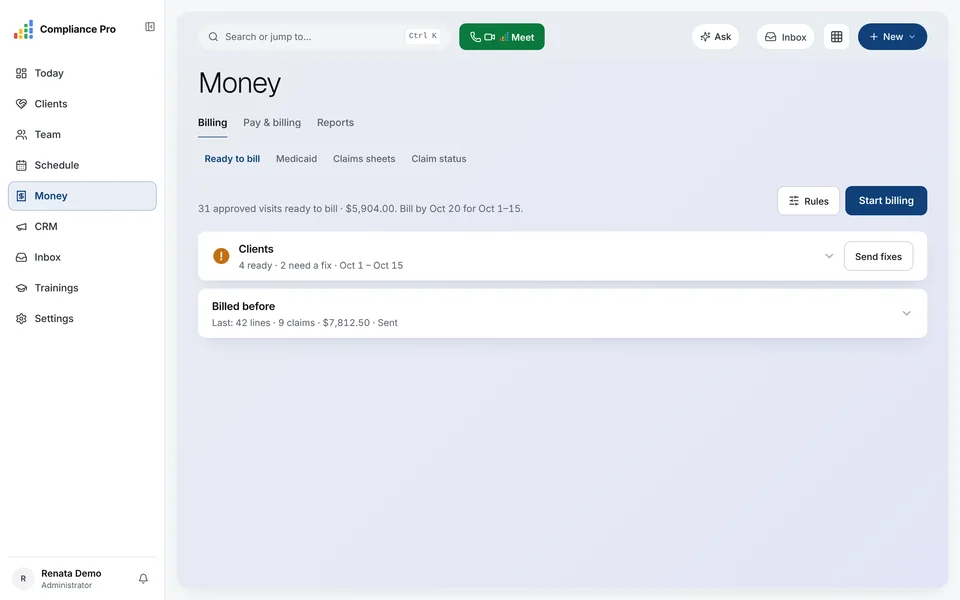
Billing is built from your ARMHS sessions and included in every plan, at a published price.
Paying a billing company a share of what you collect. Medical Economics reports headline rates of 4, 5 or 7% of collections.
With Compliance Pro
Bill on your own. $799 a month minimum on the full platform, including your first 20 clients. Each additional client is $10 a month. Never a percentage of your billing.
Assessment and plan clocks to keep: the functional assessment is updated at least every 365 days, and the individual treatment plan is reviewed every 180 days.
With Compliance Pro
Each clock is tracked per client, and notes go to the clinical supervisor’s queue for review.
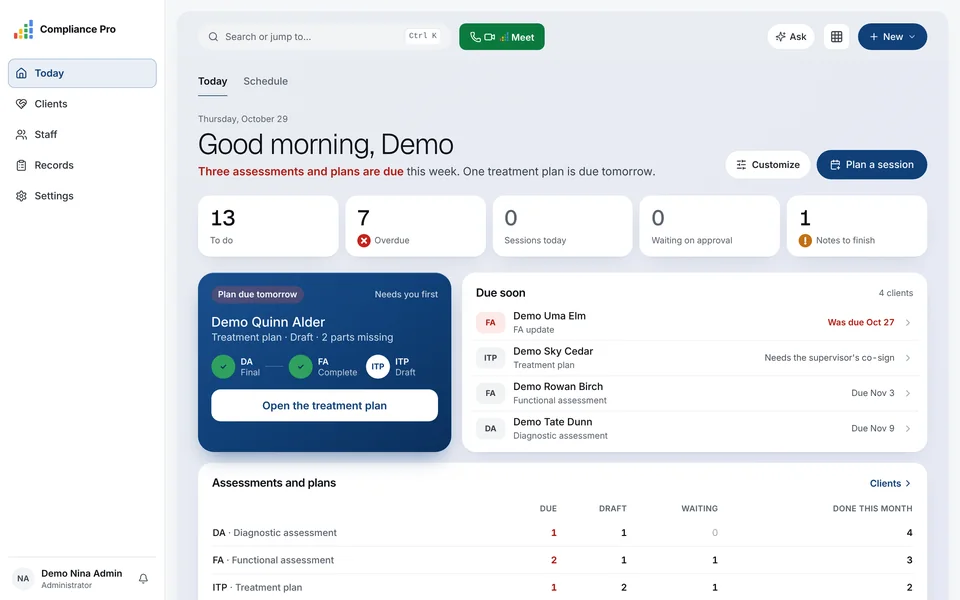
Assessments and the plan on a clock: the diagnostic assessment (DA) on file, the functional assessment (FA) at least every 365 days, the LOCUS, the individual treatment plan (ITP) within 30 days and its review every 180 days, each approved by the supervisor within 10 business days.
The client file in one place: crisis plan, releases of information, the individual abuse prevention plan and the MHIS fields.
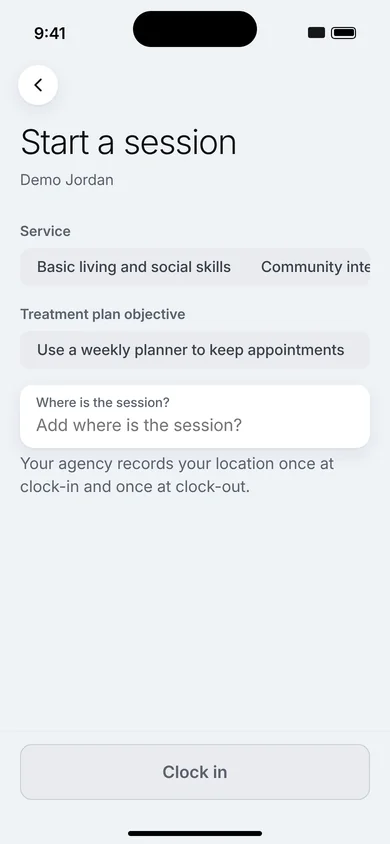
Sessions: pick the service (basic living and social skills, community intervention, certified peer specialist services, medication education, transition to community living), the treatment plan objective, individual or group, and where.
Clock in and out of each session. Location is shared only when the staff member says yes.
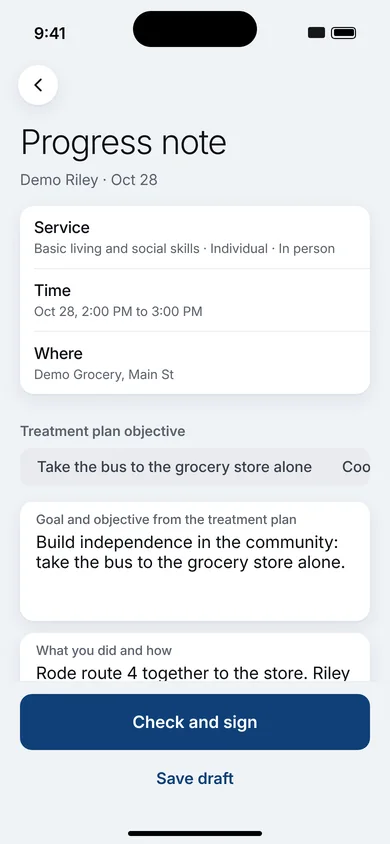
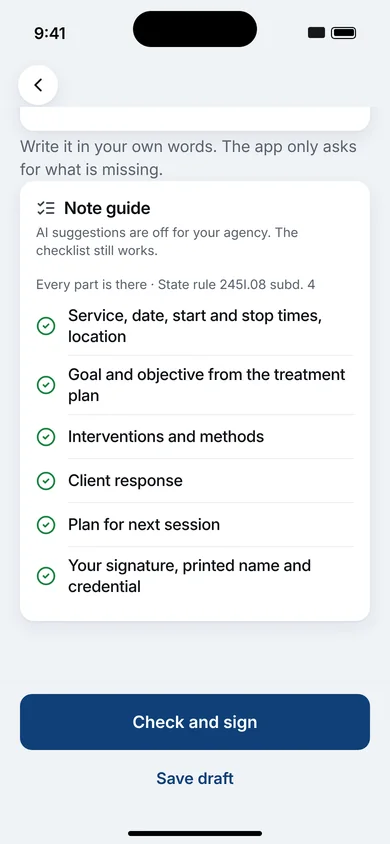
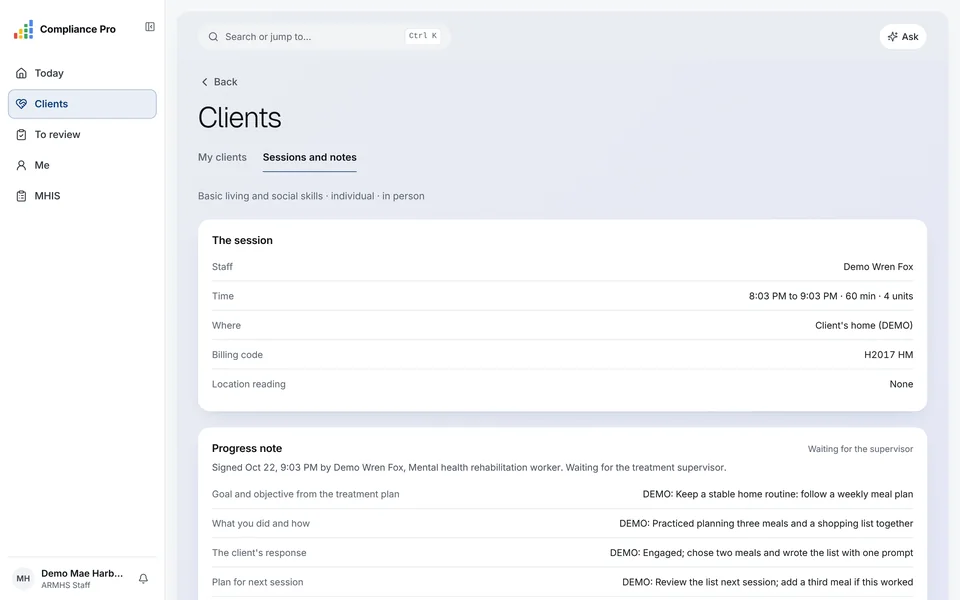
Progress notes written by the staff member, in their own words, with prompts for the goal and objective, what you did and how, the client’s response and the plan for next session.
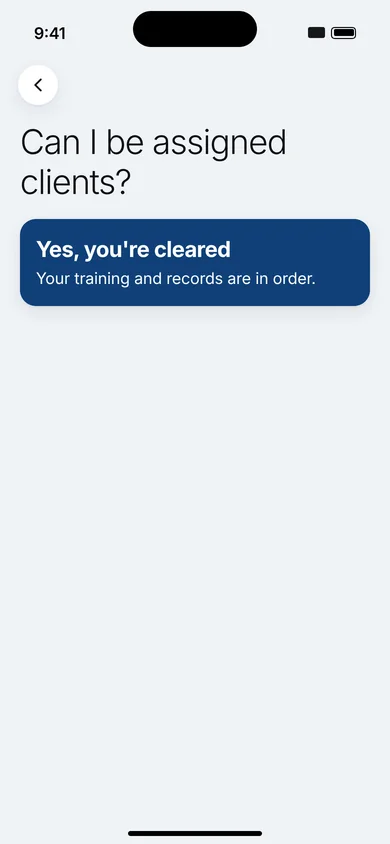
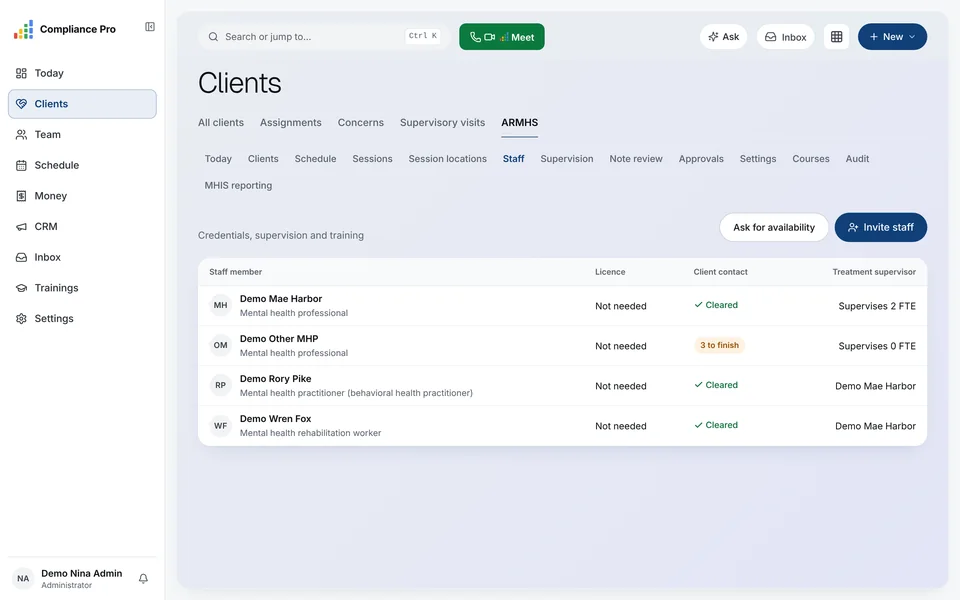
“Can I be assigned clients?”: 30 hours of training before the first session, the background study, and maltreatment reporting training within 72 hours of first contact, each with a button to fix it.
Training hours toward the 30, outside training sent to the supervisor to sign off, and certificates.
Supervision: monthly supervision and direct observations, signed in the log.
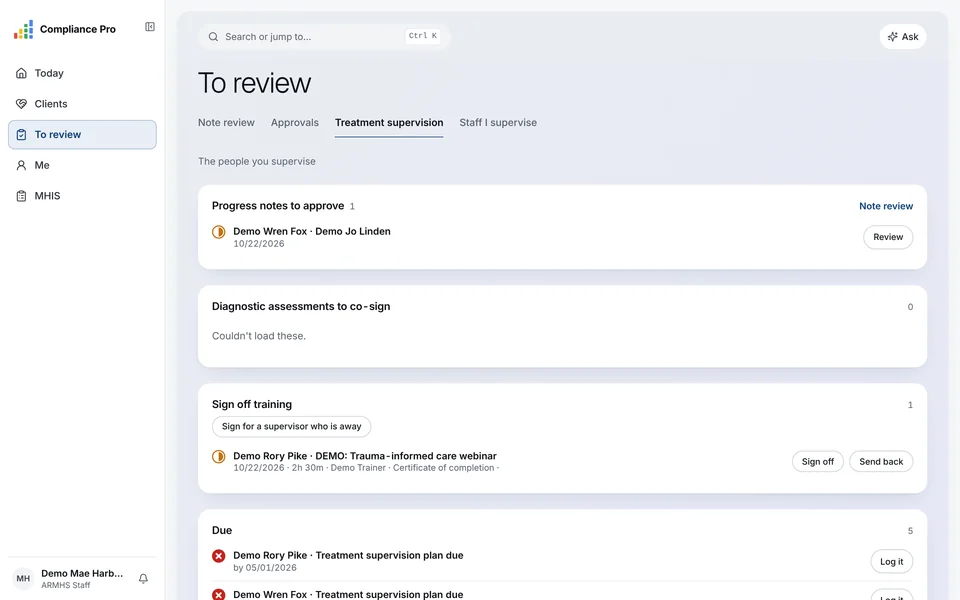
A review queue for clinical supervisors: progress notes and community interventions to approve, training to sign off, supervision and observations due, and weekly supervision for staff under 4,000 hours.
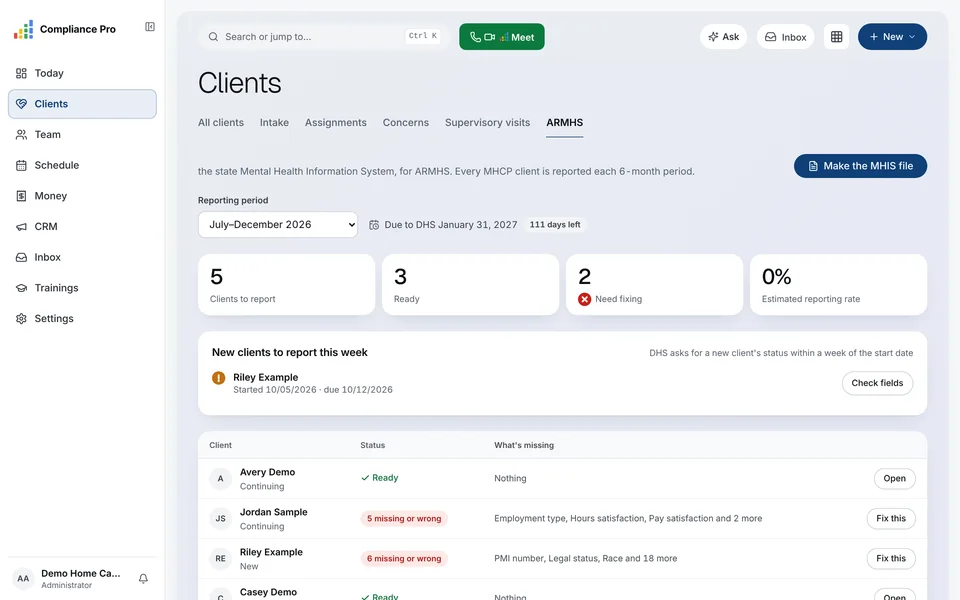
MHIS reporting: the MHIS fields collected at intake and reassessment, a readiness check before each 6-month period with a Fix button for anything missing, the MHIS file in DHS’s format, and your reporting rate with reminders before the due date.
Required documents
Every ARMHS assessment and document, with its clock
ARMHS runs in a set order: diagnostic assessment, functional assessment, level of care, then the individual treatment plan, and only then the sessions it covers. Each document below is on the client’s file with its due date, and each rule links to its source.
Eligibility and assessments
5 documents
Document
When it’s due
Who
Rule
Diagnostic assessment (DA)
On file before ARMHS starts; a standard DA shows medical necessity. Updated when the client’s condition changes markedly or they ask (no fixed interval in the statute).
Within 30 days of the ARMHS start; goals and measurable objectives with time frames, a strategy for each and who is responsible; approved by the client or guardian, who gets a copy.
Every session: type, date, start and stop times, location, the ITP goal and objective, interventions, the client’s response, the plan, and the staff signature, printed name and credentials.
Assessments, treatment plans and reviews, the individual abuse prevention plan, health care directive and emergency contacts, crisis plan, releases and discharge, kept at least 5 years after discharge.
Statutes are the 2025 edition on the Minnesota Revisor’s site; rules can change, so each link opens the current text. Demo data on every screen.
MHIS reporting
MHIS reporting, ready before it’s due
ARMHS providers report the clients they bill to Medical Assistance to Minnesota’s Mental Health Information System (MHIS) for every 6-month period. Compliance Pro gathers what MHIS asks for as you go, so the report is a short job.
Laptop · Owners and clinical supervisors
Collected at intake and reassessment
The LOCUS, housing and employment informed choice, the substance use screening and the rest are part of ARMHS intake and each reassessment. Nothing is typed twice.
A readiness check before each period
Every client billed in the period is checked. Anything missing is listed by name, with a Fix button that opens the right record.
The file in DHS’s format
One click makes the MHIS file in DHS’s batch layout, checked against that layout before you download it. You upload it in MN-ITS.
Reporting rate, with reminders
Your estimated reporting rate for each 6‑month period, and reminders 30, 14, 7 and 1 day before the due date.
The reporting rate is an estimate: clients with an MHIS record out of clients billed in the period. Demo data on the screen.
Health plans you can bill
Minnesota Medicaid (MNITS)
UCare
Medica
HealthPartners
Blue Cross and Blue Shield of Minnesota
Hennepin Health
IMCare
And more
Bill Minnesota Medicaid (MNITS), these health plans and more from one place.
Logos are trademarks of their owners. Shown to identify the plans; no endorsement implied.
How it works
A session, start to finish
Start a session
Choose the client, the service, the treatment plan objective, and individual or group.
Clock out
End the session. Sharing location is the staff member’s choice.
Write the progress note
In their own words, with the questions the note has to answer. Overdue notes are flagged.
Supervisor approves
The clinical supervisor reviews the note in the queue and approves it.
Check before you sign
Problems caught before anyone signs
Before a note, visit or plan is signed, the app checks it and says what’s wrong in plain words, which rule it comes from, and how to fix it in one tap.
Blockers stop the signature until they’re fixed.
Warnings say what to look at, like units over the authorization.
AI suggestions are labelled as AI, for staff to check before using.
Supervisors see the same flags as a count in their review queue.
Blocker
This progress note doesn’t name the ITP goal it worked on. Add the goal and objective.
Rule: ARMHS progress note requirementsAdd goal
Blocker
Basic living and social skills isn’t on this client’s authorization, so the payer will reject this claim.
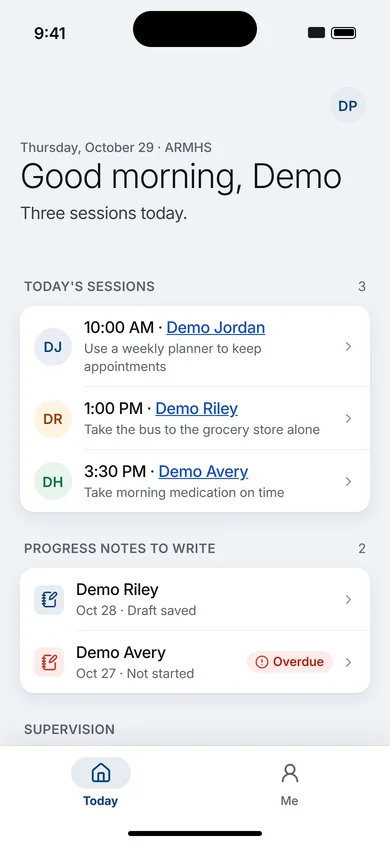
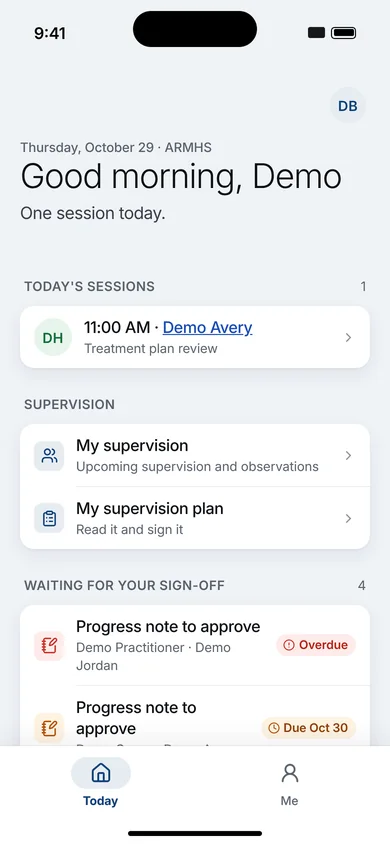
Practitioners and rehabilitation workers run sessions and write notes on the phone. Clinical supervisors approve on the go.
Sessions with clock in and out, location only with your OK
Progress notes with the ITP goal and objective
Check before you sign, so notes come back less often
Drafts kept on the phone, so a weak signal doesn’t lose a note
Supervisor sign-off on the go
Training hours and “Can I be assigned clients?”
Staff homeToday’s sessions and the progress notes to write.
Start a sessionThe service and the ITP objective you’re working on.
Progress noteThe ITP objective and the note, in your own words.
AI note guideWhat the note still needs, and wording suggestions labelled AI. You choose what to use and sign it yourself.
Can I be assigned clients?Whether your training and checks clear you to take clients.
My clients: what’s dueFA updates, ITP reviews, first ITPs and releases to collect, on the web.
Questions
Who uses the ARMHS app?
Mental health practitioners and rehabilitation workers run their sessions, notes and training from it. Clinical supervisors use the review queue to approve notes, sign off training and log supervision.
Which ARMHS documents do you track?
The diagnostic assessment, the functional assessment, the LOCUS, the individual treatment plan and its 180-day reviews, progress notes, the crisis plan, releases of information, the treatment supervision plan and the MHIS fields. Each is listed above with its rule and due date.
Does it help with MHIS reporting?
Yes. The MHIS fields are part of intake and each reassessment. Before each 6-month period, the app lists any client missing something, with a Fix button, then makes the MHIS file in DHS’s batch layout for you to upload in MN-ITS. It also shows your estimated reporting rate for each period and reminds you before the due date.
Do you take a percentage of billing?
No. $799 a month minimum on the full platform, including your first 20 clients. Each additional client is $10 a month. Never a percentage of what you bill.
Pricing
$799 a month minimum on the full platform, including your first 20 clients. Each additional client is $10 a month. Compliance only, without billing, EVV or payroll: $450 a month minimum, same per-client price. Clients in each added service on the same EIN are $10 each, under the same minimum. Unlimited staff, never a percentage of your billing.